
The First PPE World Café for Wellbeing

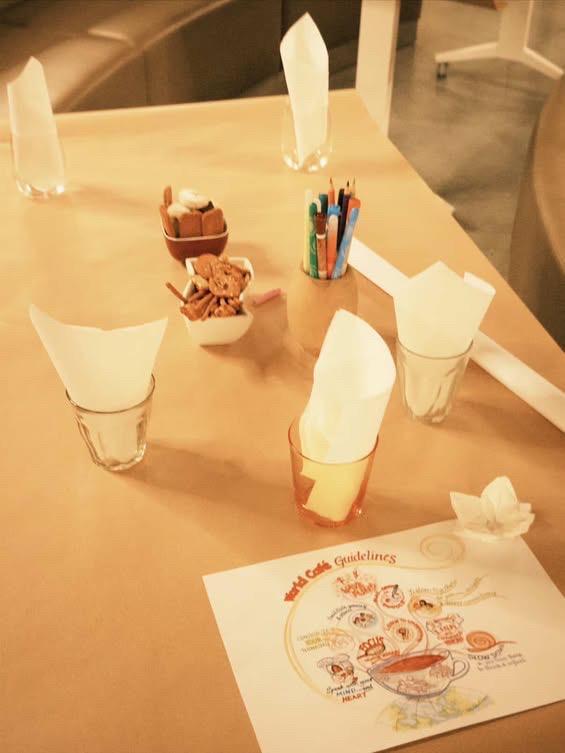
For one afternoon in November 2025, the Jinonice Campus foyer was transformed into a cozy ‘art’ café: Tables covered in craft paper, drawing and writing utensils, chill music, drinks and snacks.
This was the first PPE World Café event hosted by PPE Student Wellbeing—an initiative designed to cultivate a culture of community care, where collective inquiry and resilience are as central as individual student success.
Eleven PPE students settled in to the Café not as attendees but as contributors, exploring questions that mattered to them, their peers, and the broader PPE community. By the end of the afternoon, those questions had turned into a two-metre-long mural of words, drawings, doodles, and connections—a visual expression of the insights participants had offered to the room.
Eleven participants may sound like a small number. In practice, it was just right. The intimacy supported depth and ensured every voice was heard. Food helped. So did the small-group format. So did the freedom to express ideas visually, not just verbally. The atmosphere—cozy, playful, focused—made it easier to say what otherwise might have gone unsaid.

As one participant put it, the World Café offered a “friendly and welcoming space where people felt comfortable sharing their opinions and perspectives on life here. It was lovely to talk through how we can become more of a community and what is important for that process.”
The World Café method is disarmingly simple. Small groups gather around tables to explore carefully crafted questions. They listen, write, discuss, doodle, or draw. After each round, participants rotate, carrying ideas with them. Each exchange deepens collective understanding, helping participants discover new perspectives and common ground.
Most important, the method trusts that the people in the room already have the resources to imagine what’s possible together. The role of hosting is simply to help those resources surface. Participants look for the ‘red thread’ – the hidden line of logic and feeling that connects ideas. Insights from the collective conversation are then harvested at the end of the event.
In the practice of community-building, a carefully crafted question does the work of opening up a room to new ideas and insights. We asked three questions that November afternoon:
“What do PPE students need to thrive as a community?”
“What’s the smallest step that would make the biggest difference?”
“How do we ensure no one falls through the cracks?”
By the time we reached that third question, the students had already starting answering it. The “cracks” are filled by the very act of sitting at a table together.
Another participant added: “The World Cafe event provided a space for students to have meaningful conversations outside of the academic setting . . . this event sparked conversations that allowed me to connect with others in a way that simply isn’t possible in a classroom setting.”
Across tables and rounds, themes surfaced again and again: Students spoke of the need to guide first-years through the new environment, and considered a cross-cohort ‘academic parent’ model that provides guidance and informal check-ins without surveillance. They recognized the importance of icebreaker events so that students connect early and often in the PPE program, creating conditions for sustained cohesion across the academic journey. They repeated their desire for a stronger connection between cohorts, understanding the challenges that brings. They envisioned cultural exchanges through food and music, and a future where more regular, low-pressure gatherings like the World Cafe become a staple of student life.
“I loved the World Cafe mainly because it provided an opportunity to socialize with people from my program but from other years. It also gave us space just to talk with each other in a relaxed atmosphere . . . we discussed different issues that concern students of the PPE program, and the future events that might help in resolving them,” said one of the participants.
As the conversations unfolded, a graphic recorder listened in for patterns. She tracked recurring ideas, metaphors, and connections, translating these ‘red threads’ into images in real time. Watching her work take shape felt a bit like watching thought itself become visible.
At the end of the event, students merged their own table drawings, notes, and doodles with the graphic recording. What emerged was a living artifact: A two-metre mural that captured the energy, concerns, and hopes of the people in the space. It was a shift from seeing wellbeing as a solo endeavour to seeing it as a collective one.
The mural itself is a living object, designed to travel to more events and to grow in depth as more PPE students add to it. And this first World Cafe was just the beginning. As we move into 2026, PPE Student Wellbeing will introduce more workshops and creative initiatives using arts and theatre as tools for collective inquiry and expression. When we use arts as tools for inquiry, we aren’t trying to be artists in the traditional sense. We are using the creative process to strengthen the social fabric.

“These initiatives aren’t about performance,” says Laura Juliet Strakova, PPE Student Community Care & Engagement facilitator. “They’re about participation, about curating experiences where empathy, dialogue, and collective understanding have room to grow.”
If you were to walk into that World Cafe tomorrow, what is the “red thread” you would contribute to the mural? What is the smallest step you think would make the biggest difference to the PPE community?
Laura Juliet Strakova, MA
PPE Student Community Care & Engagement


